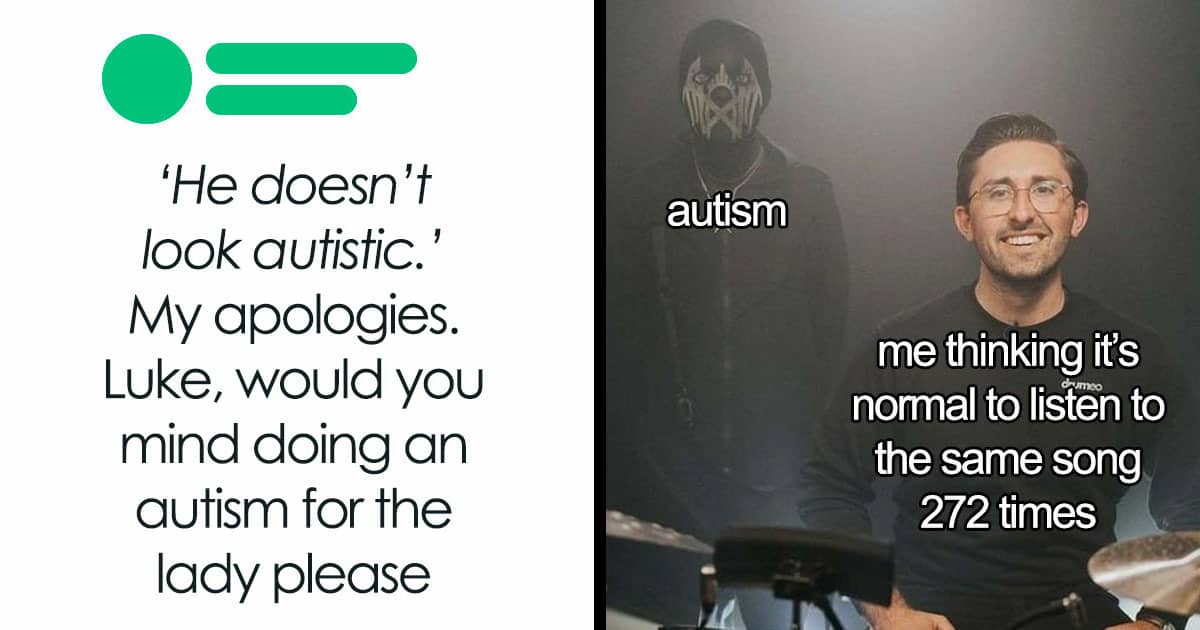

Around 1% of the world’s population is estimated to be autistic, while roughly 15% to 20% is thought to be neurodivergent. With billions of people on the planet, that adds up to a significant community. Yet because neurodivergent folks remain in the minority, they are often misunderstood by their neurotypical peers.
That is what makes finding people who truly get you feel so meaningful. There is a special kind of comfort in connecting with others who see things in a similar way and just know how your brain works.
So, we’ve rounded up some funny memes from the Autism Minds Instagram page that capture what it’s really like. Scroll down for a laugh and, hopefully, a reminder that you are not alone.
#1

#2

According to Disability Belongs, neurodivergence refers to the natural variety in how people’s brains work. The term covers autism, ADHD, dyslexia, dyspraxia, Tourette syndrome, and plenty of other ways people think, learn, and experience the world.
Sometimes neurodivergence intersects with disability, particularly when it significantly affects someone’s daily activities.
#3

#4

We’ve seen growing awareness about neurodivergence in recent years, with better representation helping people learn about these experiences. Some people even discover they’re neurodivergent themselves through this increased visibility.
Still, plenty of misunderstandings float around, fueling stereotypes and stigma that make it harder for neurodivergent people to feel fully included and supported.
#5

#6

#7

Autism, in particular, gets a lot of attention in movies, books, and online spaces. But these portrayals often feel exaggerated or one-dimensional rather than authentic. Let’s look at what autism actually involves.
The UK’s National Autistic Society points out that autism is a spectrum. Most of us have heard that phrase by now. People used to think of the spectrum like a sliding scale from “very autistic” to “barely autistic.” That’s not accurate.
#8

#9

#10

The spectrum really means that every autistic person has their own distinct mix of traits.
Two autistic people might have completely different experiences, strengths, and challenges. How noticeable these traits are can shift depending on the context, the person’s environment, or whether they’re masking their natural behaviors.
Masking happens when neurodivergent people hide their authentic traits and copy neurotypical behaviors to blend in. It’s a survival tactic. Given how much variation exists, you really can’t guess what any specific autistic person needs or can do based on assumptions.
#11

#12

#13

We’re learning more about autism all the time, but gaps remain. For example, women with autism frequently get the wrong diagnosis because the criteria were designed based on how autism shows up in men.
Research shows that roughly one in three women received an incorrect psychiatric diagnosis before getting an autism diagnosis, compared to one in four men. These wrong diagnoses often include things like personality disorders, anxiety, depression, chronic fatigue, burnout, or ADHD.
#14

#15

Never miss a story that brings joy to the world. Follow on Google News
#16

So, what does autism actually look like? As mentioned before, it varies quite a bit, but here are some common patterns the National Autistic Society highlights.
Different communication styles. Autistic people communicate differently than non-autistic people. They might interpret or use words, vocal tone, gestures, and facial expressions in their own way.
Some autistic people speak intermittently or not at all. They might express themselves through writing, signing, physical gestures, sounds, or assistive technology like picture boards or electronic devices.
#17

#18

#19

Specific behaviors and interests. Clinical language often calls these “restricted and repetitive behaviors,” framing them as something that needs managing. But many autistic people see them as helpful self-regulation tools that bring comfort and joy. Some call it “stimming.”
This might look like deep, passionate interests in particular hobbies, characters, shows, objects, or subjects. It can involve repetitive physical movements like flapping hands, twirling hair, or spinning. It often includes loving predictability and routine, like needing detailed plans, consistent schedules, the same meals, or a comforting object nearby.
#20

#21

#22

Sensory sensitivity. Autistic people might experience the world’s sensory input very differently than non-autistic people. This applies to sight, sound, touch, taste, smell, balance, movement, body awareness, and internal sensations like hunger or temperature.
Someone might be extremely sensitive to certain inputs while barely noticing others. How they react can also change based on where they are and what’s happening around them.
#23

#24

#25

One harmful myth suggests that neurodivergent people simply can’t achieve as much as others. That’s false.
With the right support and accessible environments, neurodivergent people thrive in school, careers, and life just like anyone else. They often contribute remarkable creativity, fresh perspectives, and innovative problem-solving to their communities and workplaces.
Another myth claims neurodivergent people need fixing. They don’t. What actually helps is creating welcoming spaces, respecting different thinking styles, and providing equal opportunities.
#26

#27

#28

From these memes, at least, it is clear that when people feel seen, even through humor, it can instantly make them feel better about themselves.
That is why this kind of content matters and should continue. Neurodivergent people make up a meaningful part of the population, so the more informed and understanding we are, the better.
#29

#30

#31

#32

#33

#34

#35

#36

#37

#38

#39

#40

#41

#42

#43

#44

#45

#46

#47

#48

#49

#50

#51

#52

#53

#54

#55

#56

#57

#58

#59

#60

#61

#62

#63

#64

#65

#66

#67

#68

#69

#70

#71

#72

#73

#74

#75

#76

#77

#78

#79
