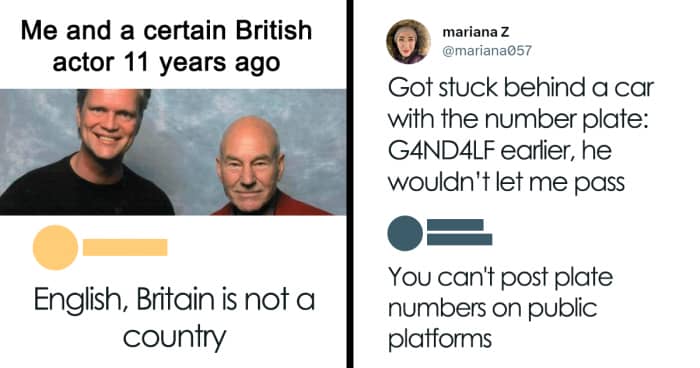

Most of us have that one friend who keeps calling out our grammar mistakes. (Of course, I won’t be as careful with my language hanging out at a bar as I would writing a uni paper, Rob.)
But as annoying as it can be, they can still play the “I can’t help it, this is really important to me” card. Some know-it-alls, however, are so insecure that they feel the need to project their “intelligence” even when they don’t have all the facts. There’s a whole Facebook group dedicated to this group, called ‘People Incorrectly Correcting Other People.’
With over 1.7 million members, this place has plenty of examples, ranging from silly and lighthearted to downright outrageous. Here are some of the most memorable ones.
#1

#2

When people disagree on an issue, there are several ways they might deal with the situation. They might avoid it altogether, either by putting off a discussion or just agreeing with the other person in order to end the conversation. On the other hand, people can be active in resolving disagreements.
Art Markman, Ph.D., an Annabel Irion Worsham Centennial Professor of Psychology and Marketing at the University of Texas at Austin, highlights that in the latter case, we have the choice between being competitive or cooperative: competitive resolution means that people are trying to convince the other person to change their belief, while cooperative resolution means that people are seeking some kind of middle ground.
#3

#4

#5

“Many factors lead people to take a cooperative or a competitive stance when dealing with a disagreement,” Markman said. “For example, the personality characteristic of openness reflects how willing people are to consider new ideas. People high in openness are more likely to be cooperative than those who are low in openness.”
“The characteristic of agreeableness reflects how much people want to get along with others. Agreeable people are also more likely to seek a compromise than disagreeable people.”
#6

#7

#8

#9

To get a better understanding of why some people need everyone to believe they’re correct, Markman suggests taking a look at a paper by Kimberly Rios, Kenneth DeMarree, and Johnathan Statzer in the July 2014 issue of Personality and Social Psychology Bulletin, which examined the way people’s certainty about their beliefs affects their tendency to be cooperative or competitive.
#10

#11

#12

“People’s certainty about their beliefs can be broken down into two components: clarity and correctness,” Markman explained.
“Clarity refers to whether people are sure about what they believe. Each of us has some beliefs that we hold deeply and others to which we are not as firmly attached. Correctness focuses on whether we think our belief is “correct” in some broader cultural or moral context.
#13

#14

#15

The authors of the paper suggested that the more strongly people believe their attitude is correct, the more competitive they will be in their discussions. In contrast, they did not assume that clarity would be as strongly related to competitiveness.
Never miss a story that brings joy to the world. Follow on Google News
#16

#17

#18

In one of their studies, participants read about a proposed tax on junk foods that would be used to defray medical expenses for people who ate unhealthy foods. Participants read about the issue and then used a scale to rate both how clear they were about their own attitude as well as whether they believed that their attitude was the “right” one to have.
#19

#20

#21

After that, participants were led to believe that they would engage in a discussion with a person who had the opposing view and were given the opportunity to select messages that would be sent to the other person before the discussion.
Some of these sentences suggested competition (“I plan on winning this debate”); some suggested cooperation (“I hope that you will also want to find some common ground on this issue”); and others reflected a desire to learn about the conversation partner’s beliefs (“I’m curious to learn about your position in this debate”).
#22

#23

#24

In the end, it turned out that the more strongly people believed that their attitude was correct, the more likely they were to select competitive sentences to introduce themselves to their partner. Being clear about the attitude, however, did not have a strong influence on people’s sentence selections.
#25

#26

#27

“Being certain of your attitude can affect whether you try to convince other people that you are right,” Markman said. “In particular, the more strongly you believe that your attitude is the right one, the more you will focus on convincing others.”
But that also means that if you find yourself in conflict with others on a regular basis, you might want to evaluate whether you generally assume that your attitudes are the correct ones. If so, you might consider discovering other people’s perspectives in order to see whether there is validity to opposing points of view. Something that folks we see in these pictures would benefit from.
For more similar examples, fire up We’s first article on‘People Incorrectly Correcting Other People.’
#28

#29

#30

#31

#32

#33

#34

#35

#36

#37

#38

#39

#40

#41

#42

#43

#44

#45

#46

#47

#48

#49

#50

#51

#52

#53

#54

#55

#56

#57

#58

#59

#60

#61

#62

#63

#64

#65

#66

#67

#68

#69

#70
